Three bodies: periodic orbits
computer-assisted certificates for 29 periodic orbits of three equal masses and three at unequal masses, and a conditional KAM result for moth I; checked within this project; not yet refereed.
computer-assisted proof; the program is not published here 32 · Lean-checked 7 · certified 5 · open 5 · certified; the program is not published here 1 · conditional; the program is not published here 1
Overview
Three stars of equal mass pull on one another by gravity. Nobody has a general formula for how they move, and most starting positions give a tangle that never repeats. The exceptions are orbits that repeat exactly, and they matter because they are the motions you can predict. In 2013 Milovan Šuvakov and Veljko Dmitrašinović published a table of fifteen starting points for such orbits, found by computer search. A computer search rounds at every step, so a near miss can look like a return. This book asks whether each row is a true repeating orbit, and it reports computer-assisted certificates. Each of the fifteen rows lies in a stated box narrower than 10⁻²¹, its Morse index is certified, and its linear stability is decided: seven rows stable and eight unstable. For the Morse indices, in the certificate summary's words: No separately written end-to-end checker from the orbit to the saved matrix exists. Sixteen more orbits from published lists, and three at unequal masses, have certificates of existence too. For one orbit, called moth I, the conditions of the KAM theorem hold under four stated premises, so that result is conditional. A short Lean file checks the conditional step for moth I, and no orbit result is proved in Lean. Still open are the Morse index and KAM for the sixteen newer orbits, and a search of the rigorous-numerics literature. To check the claims, the check guide gives a written recipe for each one and a list of file fingerprints, and a standard SHA-256 tool and Python's fractions module are enough. The book is not yet refereed.
Check it yourself
The check guide for this book · How to check a result yourself
Cite: Sonny (2026). Three bodies: periodic orbits (preliminary). Go check yourself. https://gocheckyourself.org/read/three-body/everyone/
Start here
Sonny
What this book shows
- My result. Each of the fifteen rows of the 2013 Šuvakov–Dmitrašinović table of three equal masses is a true periodic orbit (a motion that repeats exactly), in a box narrower than 10⁻²¹ near the reported start, with its Morse index (what kind of path the orbit is among nearby paths: how many independent directions lead downhill) certified and its linear stability (whether small nudges grow) decided: seven rows stable, eight unstable. Certified (computer-assisted).
- Sixteen more orbits, ten from published lists and six that follow the figure-eight word (the pattern in which the path winds around the points where two stars would collide), have the same kind of existence certificate (a computer-checked proof that a true periodic orbit lies inside a stated tiny box): 29 distinct orbits in all. The orbits were found by others; the certificates are mine. Certified (computer-assisted). For moth I, the conditions of the KAM theorem (around a stable orbit that twists in the right way, there are tubes of motion arbitrarily close to it, and motion that starts on a tube stays on it for all time) hold under four stated premises. Conditional.
- Three more orbits, at unequal masses (masses 1, 1, 3/2; 1, 1, 31/16; 1, 1, 97/80), each with its own certificate: certified (computer-assisted). Three certified orbits, at masses 1, 1, 3/2; 1, 1, 31/16 and 1, 1, 97/80, are not listed at those masses in any of the 23 catalogue sets we checked. The one at 3/2 matches no row of those sets at all; the two at 31/16 and 97/80 are linearly stable and belong to families listed at other masses (mass 2, and equal masses for moth I). The article Certified orbits that the catalogues do not list gives the details.
- Why it matters. A computer search finds orbits that look periodic, but every step rounds, so a near miss can look like a return. A certificate removes that doubt for the orbit it covers; in the sources I cite, these rows were reported from numerical work.
- In Lean: one short file proves the conditional KAM implication and exact endpoint arithmetic for moth I (7 theorems, depending on no axioms). No orbit result is Lean-proved. (Lean is a proof-checking program: it checks every step of a proof against a fixed list of rules.)
- Every theorem in this book is listed in the theorem library.
The question
Three stars of equal mass pull on one another by gravity. If you know where they start and how fast they move, how do they move afterwards? Isaac Newton wrote down the law in 1687. Two bodies have an exact answer: an ellipse if they stay bound to each other, an open curve if they fly apart, a straight line if they fall head on. For three, nobody has found a general formula, and most starts give a tangle that never repeats.
The question was put in public in 1885. King Oscar II of Sweden offered a prize for it, and the announcement asked, in our paraphrase, for the coordinates of any number of mass points that attract one another by Newton's law, with no two ever colliding, written as series in known functions of time that converge uniformly. (The prize announcement of 1885 is in Acta Mathematica 7; its English wordings differ between translations, so we do not quote one. History: June Barrow-Green, Poincaré and the Three-Body Problem, 1997.) Henri Poincaré won the prize in 1889, found an error in his own memoir, and published a corrected version in 1890. The corrected memoir showed that the motion can be chaotic, and it also showed where to look for order: in orbits that repeat exactly.
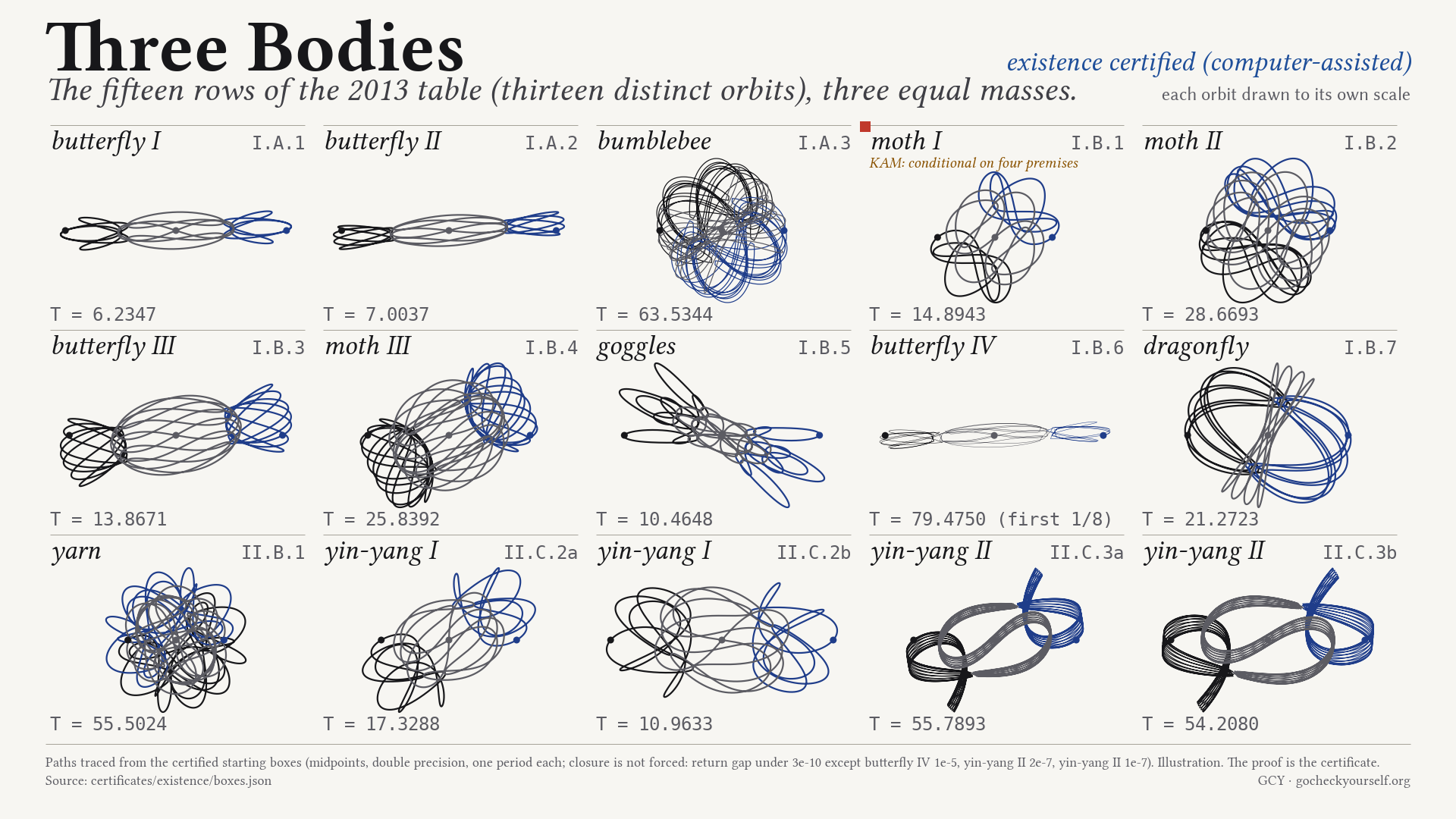
Those repeating orbits are the subject of this book. In 2013 Milovan Šuvakov and Veljko Dmitrašinović searched by computer and published a table of fifteen starting points (thirteen different orbits) for three equal masses. Their table supplies numerical starting points; interval certificates (certificates built with interval arithmetic, where every number carries a guaranteed lower and upper bound) are needed to establish a true periodic orbit for each row. The question this book answers is: is each row of that table a true periodic orbit, how does it bend (its Morse index), is it linearly stable, and for one orbit, moth I, do invariant tori (nested tubes in the space of motions; motion that starts on one stays on it) surround it? We also ask whether each is there for sixteen more orbits that other people listed from numerical searches.
The short answer is yes for existence, for all fifteen rows and all sixteen further orbits. Each lies in a stated tiny box, free of collisions. The details, with their exact labels, are below.
Why it matters
The three-body problem is the simplest case of gravity with no closed solution. Periodic orbits are the landmarks in it: they are the motions you can predict forever, and the way nearby motions behave around them (stable or unstable) shapes the whole picture. Whether an orbit is stable decides whether a configuration of three stars could last or would fly apart. A computer search finds orbits that look periodic, but every step rounds, so a near miss can look like a return. A certificate removes that doubt for the orbit it covers.
What answering it would help with
- Reference orbits with guaranteed existence give others cases to test long-time numerical integrators and validated-numerics software (software that gives guaranteed bounds on its results) against cases where the answer is known.
- The Morse index and the stability verdicts sort the many orbits found numerically into families, so that those worth deeper study can be picked out.
- The moth I result, if its four premises are examined and hold, would show invariant tori accumulating at an orbit in a system usually described as chaotic. Whether all nearby motion stays confined is open; the result gives a case for judging how often such structures occur.
- The exact boxes can serve as starting points for others who want to study these orbits with other methods or for unequal masses.
What our research shows
- What this is
- Computer-assisted certificates, checked with interval arithmetic, that each of the fifteen rows of the 2013 Šuvakov–Dmitrašinović table is a true periodic orbit of three equal masses, with its Morse index and its linear stability (7 stable, 8 unstable) (Sonny, 2026); the same kind of certificate for sixteen more orbits that other people had listed from numerical searches (Sonny, 2026); and, for moth I, the conditions of the KAM theorem, under four stated premises (Sonny, 2026). Separately, certificates for three orbits at unequal masses (Sonny, 2026), each with its own entry in the section on them.
- Still open
- KAM for every orbit other than moth I, and equal-mass orbits outside the tables. The 29 equal-mass orbits were found by Šuvakov and Dmitrašinović, by Li and Liao, and by Hristov and Hristova and their co-authors; the certificates are mine.
- Checked by
- interval-arithmetic certificates; a second solver for moth I; a second flow code (a program that follows the motion step by step), written with different software, that certified 9 of the 15 table rows on its own (the other 6 rest on one code: butterfly II, bumblebee, butterfly IV, yarn, and yin-yang II at both scales); and a written recipe for each check.
Certified: certified (computer-assisted): existence for 29 distinct orbits (the 13 orbits of the 2013 table, ten orbits from published lists and six figure-eight-power orbits), Morse index for all 13 orbits of the table (all 15 rows), linear stability for 20 of the 29. Moth I KAM: accepted, conditional on four stated premises.
Three orbits at unequal masses
These three are separate from the 29 orbits above, and each is its own result. The article Certified orbits that the catalogues do not list gives the setup, the boxes and the comparison with the catalogues.
- Masses 1, 1, 3/2, zero angular momentum. Existence, absence of collisions, least period (about 9.2391238167) and uniqueness of the multiple-shooting solution (the orbit gives the only solution of the multiple-shooting equations in the full certified shooting box): certified (computer-assisted). The closest any two stars come is more than 0.00764. Linearly unstable: proved (computer-assisted); the growth factor of a small nudge over one period lies between -427.013640011164 and -427.013640011163. A second, separately written interval check of the instability agrees. An independent run of the equations by ordinary numerical integration, written separately, agrees. Comparison with 23 sets of catalogue rows: no row matches (computed). Still open: completeness of the literature.
- Masses 1, 1, 31/16. Existence, least period 12.6204700390924, closest approach more than 0.0402, and linear stability (stable): certified (computer-assisted). An independent numerical run agrees. The orbit belongs to a family that Li, Jing and Liao (2018) listed at mass 2 (their row I.Ai.c.1 (2)); no set we checked lists mass 31/16. Still open: completeness of the literature; the stable stretch of the family, from about 1.76 to 2.10, is sampled on a grid (computed, not proved).
- Masses 1, 1, 97/80. Existence, least period 13.4210698226726, closest approach more than 0.0777, and linear stability (stable): certified (computer-assisted). The orbit belongs to the family of the 2013 row I.B.1, moth I, listed at equal masses; no set we checked lists mass 97/80. An independent run of the equations by ordinary numerical integration, written separately, agrees. Still open: completeness of the literature; the stable stretches of the family are sampled on a grid; the KAM result for moth I is at equal masses, and at mass 97/80 it is open.
The certificate files of these three orbits are in the check guide, Check 11.
What was done, in plain words
A certificate is a computer-checked proof that a true periodic orbit lies inside a stated tiny box. The plain words page, which follows on this level, explains certificates, the Morse index, linear stability and KAM, and what each does not show.
Yesterday, today, tomorrow
Yesterday. In 2013 Milovan Šuvakov and Veljko Dmitrašinović searched by computer for periodic orbits of three equal masses and published a table of fifteen starting points, which describe thirteen distinct orbits: moths, butterflies, yin-yangs and others. Later numerical studies by Li and Liao, by Dmitrašinović and colleagues, and by Hristov, Hristova and their co-authors looked at the stability of orbits of this kind and published long lists of them; those lists pointed the way to the sixteen newer orbits in chapter 4. Kapela, Zgliczyński and Simó had built interval methods that give rigorous answers about other orbits, such as the figure-eight.
Today. I gave each of the fifteen rows a certificate checked with interval arithmetic: every row's orbit exists in a box narrower than 10⁻²¹ near the reported start, its Morse index is certified, and its linear stability is decided (seven rows stable, eight unstable). For the Morse indices, in the certificate summary's words: No separately written end-to-end checker from the orbit to the saved matrix exists. For moth I, the conditions of the KAM theorem hold under four stated premises. I gave sixteen more known orbits, ten from published lists and six that follow the figure-eight word, the same existence certificate (chapter 4), and seven of the ten a certified linear verdict; for the other three the test did not finish. A second flow code certified 9 of the 15 table rows on its own and agreed with all 8 linear verdicts it reached. What each recipe reruns is in the check guide.
Tomorrow. Further research is recommended on the Morse index and KAM questions for the newer orbits (the three stable Hristov-list orbits are natural candidates), on a stability verdict for the three NOT SHOWN orbits, and on the formal identity of the six figure-eight-power orbits with catalogue entries. Others may start from the exact boxes to study these orbits further, or apply the same checks to other orbits and to unequal masses. The four premises behind the moth I result are written down so that a reader can examine them, and the size of the invariant tori around moth I is left open.
Check it yourself
The certificate files, their fingerprints, the Lean file and written recipes for the main checks ship with this book; the files not shipped are available on request. Experts: the files and checks are here: check guide.
About this research: https://gocheckyourself.org/about/#how
The chapters
- The 2013 table: who found these orbits and what a certificate adds.
- What was checked: the three questions asked of each row.
- Moth I: the KAM question and its four premises.
- Sixteen more orbits: orbits from published lists, certified here.
Beside the book, the article Certified orbits that the catalogues do not list covers the three orbits at unequal masses.
The statement files are the table of results and its JSON form. The check guide has the recipes. The plain words page, the children's version and the ode to checking explain the ideas, and the credits page lists the work this stands on. The teaching clips and an interactive page are in the media folder.
We stand on the shoulders of giants: Poincaré, Šuvakov and Dmitrašinović, Li and Liao, Li, Jing and Liao, Hristov and Hristova, Kapela, Zgliczyński and Simó, and many more.
Where to go next
- Is an orbit that is "barely stable" really stable, and what would show it? See What was checked.
- If the four premises hold, what exactly do the tori around moth I tell us about the three stars? See Moth I.
- Which of the sixteen newer orbits might be next to receive a Morse index or a KAM check? See Sixteen more orbits.
Go check yourself.
Have a question about this? Ask it
What the words mean
What the words mean
The question: what do the four words in this book (existence, Morse index, linear stability and KAM) ask about an orbit, and what do their answers leave unsaid? The answer in brief: each word is one question about a repeating orbit of three stars; the sections below give each in plain words and in expert words.
Three stars of equal mass pull on one another by gravity. Usually the motion is a tangle. Some starting points repeat exactly: after a time T, all three stars are back where they began, moving as they began. That is a periodic orbit. In 2013 Šuvakov and Dmitrašinović found a table of them by computer. The four words below are the four questions asked of each one.
Each idea below has a short silent clip (click the picture to play it; a phone-size copy and captions are in the teaching media folder). To try the same ideas by hand, download the interactive page and open it in a browser; it works offline. The clips and the page are illustrations: the proof is the certificate.
Three stars trace moth I and come back to their dashed starting rings
What a search, a certificate and the other checks do and do not show
A numerical search follows a starting point on a computer and watches whether the stars come back to where they began. It indicates that an orbit very probably exists. Because every step rounds, it cannot rule out that a near miss looks like a return.
A certificate is a computer-checked proof that a true periodic orbit lies inside a stated tiny box. It uses interval arithmetic, in which every number carries a guaranteed lower and upper bound, so every rounding is accounted for, and a Krawczyk test, which shows that inside the larger box the computer works in, the equations for a periodic orbit have exactly one solution. The certificate establishes that periodic orbit. Stability, the Morse index and other orbits each need their own check.
The Morse index says what kind of path the orbit is among nearby paths: how many independent directions lead downhill in the action. Stability needs its own test.
Linear stability says whether small nudges grow. Its scope is the straight-line approximation of a nudge. The long-time effect of larger nudges needs a separate argument.
KAM says that, around moth I and under the four stated premises, there are invariant tubes arbitrarily close to the orbit, and motion that starts on a tube stays on it for all time. The scope is moth I under those premises. Still open: tube sizes and the behaviour of nearby motions between the tubes.
Existence: is the orbit really there?
A computer search gives numbers with rounding in every step, so it shows that an orbit is very likely near a starting point, not that it is there. Here the computer carries a guaranteed lower and upper bound for every number (interval arithmetic). A standard test (Krawczyk's) then shows that a true periodic orbit sits in a tiny box near the reported start, and that this orbit is the only solution of the equations the computer solved in the larger box it worked in. The same bounds show that no two stars ever collide on the way, that the period is not secretly a shorter one repeated, and that the path winds around the collision points in the pattern the 2013 table names.
Every number of moth I's start as a bracket, beside a zoom of 22 powers of ten onto the certified box
Morse index: how does the orbit bend?
Nature's paths make a quantity called the action stationary, like a ball resting at a point where the ground is flat. The flat point can be the bottom of a valley, the top of a hill, or a saddle. The Morse index counts how many independent directions lead downhill. It describes the shape of the action around the orbit. It is not the same as being unstable.
Linear stability: do small nudges grow?
Give the stars a tiny push and watch one period. If, to a good approximation, the push only makes the motion wobble and never grow, the orbit is linearly stable. If some push grows each period, it is unstable. Of the fifteen rows, seven are stable and eight are unstable.
Yin-yang II and goggles, each beside a nudged copy, with the gap after each trip plotted below
Question: Give moth I a tiny push. Will a second copy, started with the push, stay close to the first, or drift away?
- It stays close.
- It drifts away.
Answer: It stays close: moth I is linearly stable, so a tiny push only makes a small wobble. An unstable orbit such as goggles does the opposite, and its copy drifts far. Try both in the figure below.
[interactive figure: see the web edition]
KAM: does it stay stable for good?
Linear stability only looks at the straight-line approximation of a push. The full question, whether nearby motion stays close for all time, is the question Poincaré's corrected prize memoir opened in 1890, when he found that motion near a periodic orbit can be chaotic.
Butterfly I from two starts ten decimal places apart, moving as one and then parting
The KAM theorem (Kolmogorov, Arnold, Moser) gives part of the answer. Around a stable orbit that twists in the right way, there are invisible tubes (tori) in the space of motions. Motion that starts on one of these tubes stays on it forever. There are such tubes arbitrarily close to the orbit. Motion that starts between the tubes is not covered: with three bodies, slow drift between them is not ruled out. For moth I, the conditions of the theorem have been checked, so these tubes exist around it, under four stated premises (listed in the check guide).
Dots of a Poincaré section around moth I lining up on nested closed curves, in two views
Where to go next
- Which of the four premises can a reader examine most easily? See Moth I.
- Do the sixteen newer orbits answer the same four questions? See Sixteen more orbits.
Yesterday, today, tomorrow
Yesterday: In 2013 Milovan Šuvakov and Veljko Dmitrašinović found by computer a table of repeating orbits for three equal stars, and gave them names such as moth, butterfly and yin-yang. Other people studied the stability of orbits like these with careful numerical computing. Kapela, Zgliczyński and Simó had built methods that give guaranteed answers about other orbits, such as the figure-eight.
Today: I gave all fifteen rows of the 2013 table a guaranteed answer, using interval arithmetic: each number is kept with a lower and an upper bound. All fifteen rows are really there (they describe thirteen different orbits, because some rows are the same orbit at two scales), each in a box narrower than 10^-21 near the reported start. Seven are stable and eight are unstable. For moth I, the conditions of the KAM theorem hold under four stated premises, written in the check guide. Sixteen more orbits that other people had listed from numerical searches (ten from published lists, six that follow the figure-eight word) also have certificates, and seven of the ten have a certified stability verdict; chapter 4 gives them.
Tomorrow: People may build on the exact boxes, or ask the same questions of other orbits; the Morse index and KAM questions for the newly certified orbits are open, and further research is recommended. For the Morse indices, in the certificate summary's words: No separately written end-to-end checker from the orbit to the saved matrix exists. The four premises can be read and tested by anyone. How big the invariant tubes around moth I are is still an open question.
An ode to checking
An ode to checking
In 1885 a king paid for a question.
For his sixtieth birthday, Oscar II of Sweden offered
a gold medal and 2,500 kronor
for progress on bodies that pull on one another under gravity.
Henri Poincaré answered,
and on 21 January 1889 the prize was his.
Then the memoir went to press in Stockholm.
Edvard Phragmén, reading the proofs, kept asking about one delicate point.
In late 1889 Poincaré found the error behind it.
He stopped the presses,
paid more than 3,500 kronor for the printing, about a thousand more than the prize,
and wrote it again.
The corrected memoir, printed in 1890, is where the study of chaos took root.
Defend the kronor:
check the work before it goes out.
A reader who finds a fault is part of the work.
In 2013 Milovan Šuvakov and Veljko Dmitrašinović searched by computer
and found periodic orbits for three equal masses:
fifteen starting points, thirteen orbits, one table.
You have no way to look for something
if you do not know it exists.
They found them, and every certificate of the fifteen rows is built on what they found.
Each of those fifteen rows now has a certificate.
Interval arithmetic brackets every number,
so the work can be checked again:
that the orbit is there, how it bends, whether it is linearly stable,
and, for moth I, the KAM tori around it, under four stated premises.
We encourage others to take part in checking this work.
We make no assertions outside the stated conditions,
and invite you to join the long history of people checking each other's work.
I keep the certificates. Go check yourself.
We stand on the shoulders of giants.
Dates and sums are from the Institut Mittag-Leffler's history of the prize competition, which cites June Barrow-Green, "Oscar II's prize competition and the error in Poincaré's memoir on the three body problem", Arch. Hist. Exact Sci. 48 (1994) 107–131, and Poincaré and the Three-Body Problem (AMS/LMS, 1997). The sums and dates have not yet been checked against Barrow-Green's book itself.
Where to go next
- What exactly was checked for each of the fifteen rows? See What was checked.
- What is the story behind Poincaré's error? See the kids' version and the credits page.
We hope it helps others find more results and keeps their curiosity going. We'd love to collaborate with anyone.
Try it yourself
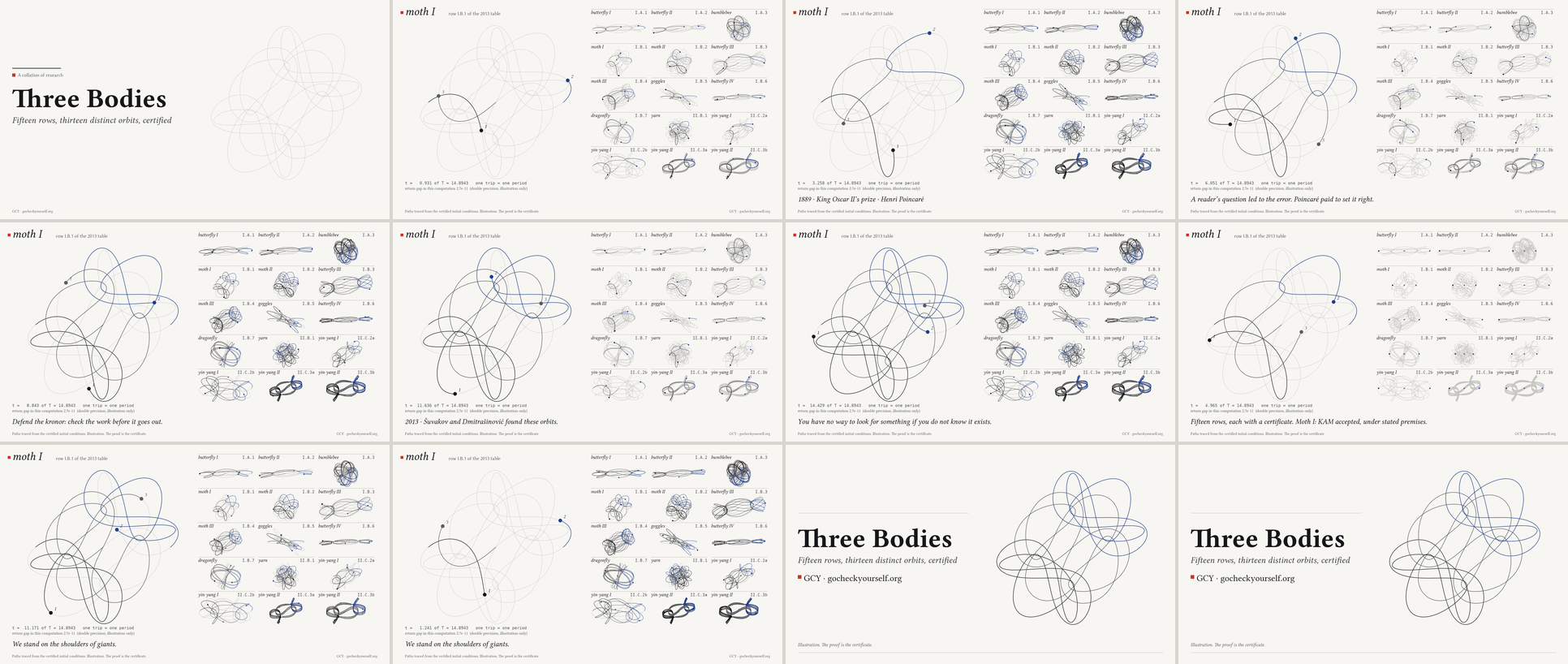
The figures of this chapter are the book's media files: three-bodies-entrance-contact-sheet.png, three-bodies-entrance-phone.mp4, three-bodies-entrance-square.mp4, three-bodies-entrance.mp4, three-bodies-entrance.vtt, three-bodies-poster.png.
Articles
Each result on its own page
- Proposition 1: the figure-eight, run as a control
- Theorem 2: butterfly I (I.A.1), a periodic orbit with its Morse index and linear stability
- Theorem 3: butterfly II (I.A.2), a periodic orbit with its Morse index and linear stability
- Theorem 4: bumblebee (I.A.3), a periodic orbit with its Morse index and linear stability
- Theorem 5: moth I (I.B.1), a periodic orbit with its Morse index and linear stability
- Theorem 6: moth II (I.B.2), a periodic orbit with its Morse index and linear stability
- Theorem 7: butterfly III (I.B.3), a periodic orbit with its Morse index and linear stability
- Theorem 8: moth III (I.B.4), a periodic orbit with its Morse index and linear stability
- Theorem 9: goggles (I.B.5), a periodic orbit with its Morse index and linear stability
- Theorem 10: butterfly IV (I.B.6), a periodic orbit with its Morse index and linear stability
- Theorem 11: dragonfly (I.B.7), a periodic orbit with its Morse index and linear stability
- Theorem 12: yarn (II.B.1), a periodic orbit with its Morse index and linear stability
- Theorem 13: yin-yang I (II.C.2a), a periodic orbit with its Morse index and linear stability
- Theorem 14: yin-yang I (II.C.2b), a periodic orbit with its Morse index and linear stability
- Theorem 15: yin-yang II (II.C.3a), a periodic orbit with its Morse index and linear stability
- Theorem 16: yin-yang II (II.C.3b), a periodic orbit with its Morse index and linear stability
- Theorem 17: the orbit Hristov list #5, existence and linear stability
- Theorem 18: the orbit Li-Liao I.B_7 (Euler #2023), existence and linear stability
- Theorem 19: the orbit Li-Liao I.A_3 (Euler #4), existence and linear stability
- Theorem 20: the orbit Hristov list #9, existence and linear stability
- Theorem 21: the orbit Li-Liao II.C_2 (Euler #64), existence and linear stability
- Theorem 22: the orbit Hristov list #10, existence and linear stability
- Theorem 23: the orbit Hristov list #29, existence
- Theorem 24: the orbit Li-Liao II.C_61 (Euler #96), existence and linear stability
- Theorem 25: the orbit Hristov list #67, existence
- Theorem 26: the orbit Hristov list #87, existence
- Theorem 27: the orbit that repeats the figure-eight word 17 times, period 116.22, existence
- Theorem 28: the orbit that repeats the figure-eight word 18 times, period 85.49, existence
- Theorem 29: the orbit that repeats the figure-eight word 11 times, period 55.91, existence
- Theorem 30: the orbit that repeats the figure-eight word 10 times, period 77.42, existence
- Theorem 31: the orbit that repeats the figure-eight word 9 times, period 74.73, existence
- Theorem 32: the orbit that repeats the figure-eight word 10 times, period 72.92, existence
- Proposition 33: the thirty orbits are pairwise distinct
- Proposition 34: yin-yang II is linearly stable at both scales
- Proposition 35: a second flow code on the fifteen rows, partial confirmation
- Theorem 36: invariant two-tori accumulate at moth I
- Theorem 37: a KAM criterion applied to the seven hypotheses gives invariant tori
- Theorem 38: the twist determinant alone does not supply the other six hypotheses
- Lemma 39: the endpoint denominators of the twist determinant are positive
- Lemma 40: the endpoints of the twist determinant are in order
- Lemma 41: the upper endpoint of the twist determinant is negative
- Lemma 42: an outward lower bound on the twist determinant
- Lemma 43: an outward upper bound on the twist determinant
- Theorem 44: a periodic orbit at masses 1, 1, 3/2 that the catalogues checked do not list
- Theorem 45: a linearly stable periodic orbit at masses 1, 1, 31/16
- Theorem 46: a linearly stable periodic orbit at masses 1, 1, 97/80, in the family of moth I
- Open question: Morse index and KAM for the sixteen newer orbits
- Open question: Linear stability of three orbits from the published lists
- Open question: Formal identity of the six figure-eight-power orbits with catalogue entries
- Open question: Size of the tori around moth I, and slow drift
- Open question: A search of the rigorous-numerics literature for the sixteen