Navier–Stokes: the original 2000 question: what is proved, and what is open
each result is marked proved in writing, Lean-checked (a program that checks every step of a proof), cited, computed or open; the key results were also accepted by two separately written kernel checkers; not yet refereed.
proved in writing 35 · Lean-checked 23 · open 7 · cited 5 · computed; the program is not published here 1
Overview
The Navier-Stokes equations describe how water and air move. The Clay Mathematics Institute's problem, published in 2000, asks four questions, (A) to (D): whether a fluid that starts smooth stays smooth, or can break down, in all of space or in a box whose opposite sides join up like wallpaper, with or without an outside push. This book takes the original 2000 wording at its word, and it finds that the answer to (D) depends on how that wording is read. It shows that, from rest, every allowed push has a smooth flow that lasts forever, because the printed text does not require the pressure to repeat. That is proved in writing, with every step but one also checked in Lean, a program that checks every step of a proof, and accepted by two separately written checkers, nanoda and lean4lean; that a series in the proof's H³ bound converges is checked in writing. The book also lists 440,401,920 readings of the problem, each with its verdict and how it was decided: in Lean, in writing, or from cited theorems. Questions (A) and (B) are still open, and so is (D) from other starting states. OpenAI's 2026 breakdown in all of space is credited to them and is not yet refereed. A reader can check the claims with the written recipes in the check guide and the shipped Lean files.
Check it yourself
The check guide for this book · How to check a result yourself
Cite: Sonny (2026). Navier–Stokes: the original 2000 question: what is proved, and what is open (preliminary). Go check yourself. https://gocheckyourself.org/read/navier-stokes/everyone/
Start here
Navier–Stokes: Four Questions, Every Reading, the Answers So Far · Sonny
What this book shows
- My result. Under the original 2000 wording, a fluid that starts at rest in the repeating box never has to break down, whatever allowed push acts on it: there is always a smooth flow that lasts forever, with a pressure that need not repeat. Proved in writing, with every step but one also checked in Lean (a program that checks every step of a proof), and accepted by two separately written kernel checkers, nanoda and lean4lean (different judges, written by different people, each given the proof as plain text); that the series in its H³ bound (a measure of how smooth the flow stays) converges (its infinite sum settles to a finite value) is checked in writing.
- Why it matters. The 2000 wording requires the flow's velocity to repeat across the box, but sets no such condition on the pressure. So the problem as printed is already met by a flow from rest that never breaks down, and a breakdown that starts from rest cannot answer (D) as printed (D is one of Clay's four questions, explained further on). For other starting states, (D) stays open.
- Clay's 2000 statement and its later correction, written out in Lean, with every reading of the clauses checked against them.
- Tao's link between (B) and (D) (Tao, 2011, cited), and (B) as the same question under both wordings, proved in Lean.
- Every theorem in this book is listed in the theorem library.
This begins with Terence Tao. In 2011 he noticed that the printed problem never asks the pressure to repeat, sketched what follows, and asked the question that became his Conjecture 1.8. I took his idea and carried it through: the case that starts from rest, for all time, with no extra assumption, proved in writing, with every step but one also checked in Lean (that the series in its H³ bound converges is checked in writing), and an answer to his question that rests on OpenAI's construction.
Clay's problem, published in 2000, asks for one of four things, (A) to (D). Each asks whether a fluid that starts smooth stays smooth, with or without a push (an outside force), either in all of space or in a repeating box (a box whose opposite sides join up, so the flow repeats like wallpaper). This book takes the original 2000 wording at its word and answers each part as far as it can now be answered.
Under the original 2000 wording:
- (D) Repeating box, with a push: open as printed; from rest, it need not break down. From rest, every allowed push, OpenAI's included, has a smooth flow that lasts forever: the 2000 wording does not require the pressure to repeat, so the whole fluid can drift through the box. This second smooth solution does not contradict OpenAI, whose result is about flows whose pressure repeats. For other starting states, (D) stays open: on every finite time interval, (D) holds exactly when (B) fails, by Tao's Proposition 1.7 (2011); for all time this holds only if the version his Remark 6.2 sketches, with the details omitted, holds; cited, not rechecked in Lean. My idea: Tao's 2011 argument needed an unproven assumption, and for a fluid starting from rest that assumption holds trivially. I proved the full statement, for all time and every allowed push, and checked every step but one in Lean; that the series in its H³ bound converges is checked in writing.
- (C) All of space, with a push: it can break down. OpenAI (2026) gives a breakdown (not yet refereed). (C) and (D) are different settings: (C) is all of space, (D) the repeating box.
- (B) Repeating box, no push: open. It is the same question under Clay's later correction (observed by Tao, 2011; proved in Lean by Sonny).
- (A) All of space, no push: open.
Clay's correction. Clay later added an erratum (a published correction), undated, at the end of the problem statement; it also states that the pressure must repeat, and reprints Eqn (10). Under it, a breakdown from rest answers (D), and OpenAI's construction gives one: see the statement and the proof. Clay has not announced a decision on any of these answers, and no prize has been awarded (its Navier-Stokes page lists the problem as "Active").
The detail
Clay's Navier-Stokes prize problem asks about water and air in four settings. In (A) and (B) nothing pushes the fluid: does every smooth start stay smooth forever, in all of space (A) or in a box that repeats like wallpaper (B)? In (C) and (D) a push is allowed: can some smooth flow break down, in all of space (C) or in the repeating box (D)?
What I proved
I proved these results in Lean, against Clay's own clauses. Where noted, nanoda and lean4lean, two separately written programs, checked Lean's work again.
- Under Clay's 2000 wording, from rest, every push has a smooth flow that lasts forever: the answer to (D) depends on the wording. The fluid slides through the box, with a pressure that tilts across space. Printed (D) asks the solution only for (1), (2), (3), (10) and (11): the equations, the start, a repeating velocity and smoothness, with no energy bound. The slide meets these, and in the Lean statement its speed and the energy in each cell also stay bounded for all time. There is no contradiction with OpenAI's result: same push and same start, but a different solution, whose pressure does not repeat. My idea: starting from rest, Terence Tao's 2011 slide (Proposition 1.7; for all time, sketched in Remark 6.2 with the details omitted) needs no assumption, because the resting fluid is already an unforced solution, so it applies to every push in Clay's class, OpenAI's included. I wrote a complete proof, for all time, of the case from rest, and checked every step but one in Lean (nanoda, lean4lean); its H³ bound is stated in Lean, but without the clause that its series converges; that step is checked in writing. Chapter 4
- (A) and (B) under readings that add a condition the text does not contain, such as finite energy over all of space, a smooth extension before time zero, zero average velocity or an extra integral identity. I decided most of these readings, in Lean and nanoda for most of them and in writing for the rest. Those still open are stated exactly. Chapter 8 gives all 440,401,920 readings, each with its verdict and basis.
- The construction, tested against every reading. I tested OpenAI's push from rest against every reading of (D) in chapter 8. It answers (D) where flow and pressure must both repeat, or where an added condition forces that or settles (D) by itself. It does not answer (D) under the 2000 wording from rest, nor under most readings with weak solutions (solutions that are allowed to be rough), a pressure repeating only at time zero, a smooth zero extension or one push for every viscosity; chapter 8, section 4 lists each, the open ones included. Lean for the main cases; written or cited for the rest.
- OpenAI's Lean package, checked against Clay's clauses. I ported the package to a pinned toolchain (a fixed set of software versions), rebuilt it with only the standard axioms (starting assumptions Lean accepts without proof), and checked its statements of (C) and (D) against Clay's wording. nanoda accepted both; lean4lean accepted (D). Chapter 3
- (D) under the correction read word for word (the flow itself need not repeat). Without repeating pressure, the same slide works, so no breakdown from rest answers (D). With repeating pressure, (D) is open for OpenAI's push. I proved that, for any repeating push, a competing flow growing at most linearly in space must repeat (Sonny (2026); Lean, nanoda). I then proved that any escape for OpenAI's push must grow faster than linearly (far away, its speed outruns every fixed multiple of the distance) before the breakdown time (Sonny (2026); Lean, nanoda). Chapter 6
Checked in Lean against Clay's wording: (B) is the same question under both wordings (Tao, 2011, p. 6 and Lemma 4.1); proved in Lean against Clay's clauses by Sonny. With no push, a smooth flow with repeating velocity exists from a given start exactly when one with repeating velocity and repeating pressure exists. Chapter 5
Tao's 2011 question, Conjecture 1.8, now has an answer: no. I answered it, and checked it in Lean for every period.
A conjecture is a careful guess, posed so that others can test it. Tao proposed this one in 2011 as a repaired form of Clay's box problem. The answer is no. I showed, and proved in Lean for every period, that OpenAI's Corollary 10.6 answers Tao's Conjecture 1.8 (the answer is no): by Tao's footnote 4, normalised pressure is periodic pressure up to a constant, and Corollary 10.6 rules out a smooth solution with periodic pressure. Two short written steps connect the Lean definitions to Tao's words (the Conjecture 1.8 written steps). Start from rest with OpenAI's push at viscosity 1, which is smooth and repeats with period 1. For every end time T of 1 or more, there is no smooth periodic solution on [0, T] with normalised pressure (a pressure that repeats with the flow). This holds under each reading of Tao's normalisation and whatever period the solution has. Corollary 10.6 is OpenAI's own Lean theorem, rebuilt and checked in this book. The unforced case, Tao's Conjecture 1.4, is open. Sonny (2026); Lean, nanoda. Chapter 4
What OpenAI proved
- (C), all of space, with a push. The OpenAI team built the construction (OpenAI, 2026), in which a smooth push drives a fluid to break down at time 1. The mathematics of the construction is OpenAI's.
- (D) under the correction as intended, from rest: can break down, yes, by the same construction, with flow and pressure both repeating. OpenAI's README describes their results as alternatives (C) and (D) "in the Clay Mathematics Institute's official problem description". Chapter 3
What this means for the Clay prize
The Clay Institute decides. Its wording leaves room for interpretation, which is why this book gives the answer under every reading, and the Institute may weigh every reading, the results here included. The classical questions, (A) and (B) with nothing added, are still open. (C) is answered yes (OpenAI, above; not yet refereed).
The question
Water and air move by the Navier-Stokes equations. Can a smooth flow, starting calmly, break down in finite time, or does it always carry on smoothly? In 2000 the Clay Mathematics Institute named this one of its seven Millennium Prize Problems, and Charles Fefferman wrote the official description. A proof of any one of its four alternatives, (A) to (D), answers the problem. The description says, for alternative (A):
"(A) Existence and smoothness of Navier-Stokes solutions on R³. Take ν > 0 and n = 3. Let u°(x) be any smooth, divergence-free vector field satisfying (4). Take f(x, t) to be identically zero. Then there exist smooth functions p(x, t), u_i(x, t) on R³ × [0, ∞) that satisfy (1), (2), (3), (6), (7)."
(C. L. Fefferman, Existence and smoothness of the Navier-Stokes equation, as hosted by the Clay Mathematics Institute. The other three alternatives are quoted in the exact statements page.)
Two doors say "it always works": start the flow calmly, give it no push, and it stays smooth forever. Two doors say "it can break": some calm start plus some push makes the flow break down. Each kind comes in two places, all of space or a box that repeats like wallpaper.
| No push: it always works | With a push: it can break | |
|---|---|---|
| All of space | (A) every calm start stays smooth forever | (C) some start and push make it break down |
| A box that repeats like wallpaper | (B) every calm start stays smooth forever | (D) some start and push make it break down |
A few sentences in the text can be read more than one way: whether the pressure repeats too, what "smooth" and "finite energy" mean, and whether weak or strong solutions are meant. Chapter 1 lays the four alternatives out.
The description now ends with an erratum, which says: "The further condition p(x + e_j, t) = p(x, t) should be made explicit in Eqn (8)." That adds a requirement that the pressure repeat in the box. It also says "Eqn (10) should read:" and prints a corrected equation under a label that does not match it. Chapter 2 gives the exact text and the ways it can be read. The question this book answers is: under every reading the wording allows, of the 2000 text and of the erratum, which of the four alternatives is answered yes, which is answered no, and which is still open, and how was each answer checked?
Why it matters
The Navier-Stokes equations are the standard model of flowing water and air. Whether their smooth solutions can break down is one of the most famous open questions in mathematics, and the Clay Institute offers a prize for settling it. Whether a claimed answer counts depends on the exact wording of the problem, and the wording can be read in more than one way. A claim of an answer is only as good as the reading it is made under.
What answering it would help with
- A table of verdicts under every reading lets later papers say plainly which wording and which alternative they address.
- Knowing which readings leave the question open points work at the cases that are still undecided, such as (A) and (B) in their classical form.
- The Lean statements, kept beside the plain-words descriptions, let readers judge how closely a formal result matches the English problem (see chapter 7).
What our research shows
How to read the answers. Each row says what its yes means. For (A) and (B): stays smooth, yes or no. For (C) and (D): can break down, yes or no. Open means nobody knows yet. "From rest" means the answer is given for a start from rest. Where (A) or (B) is no under a reading that adds a condition, no smooth solution exists under that reading; this comes from the added condition, not from a breakdown. A "no" is a proved result, just as a "yes" is.
What this is: The answer key: for each way of reading Clay's 2000 Navier-Stokes problem text, and for the erratum wording, the verdict on each of the four alternatives (A) to (D), who answered it, the reason, and how it was checked (Lean, a separately written proof checker, a written proof, or a classic theorem we cite).
The answer key
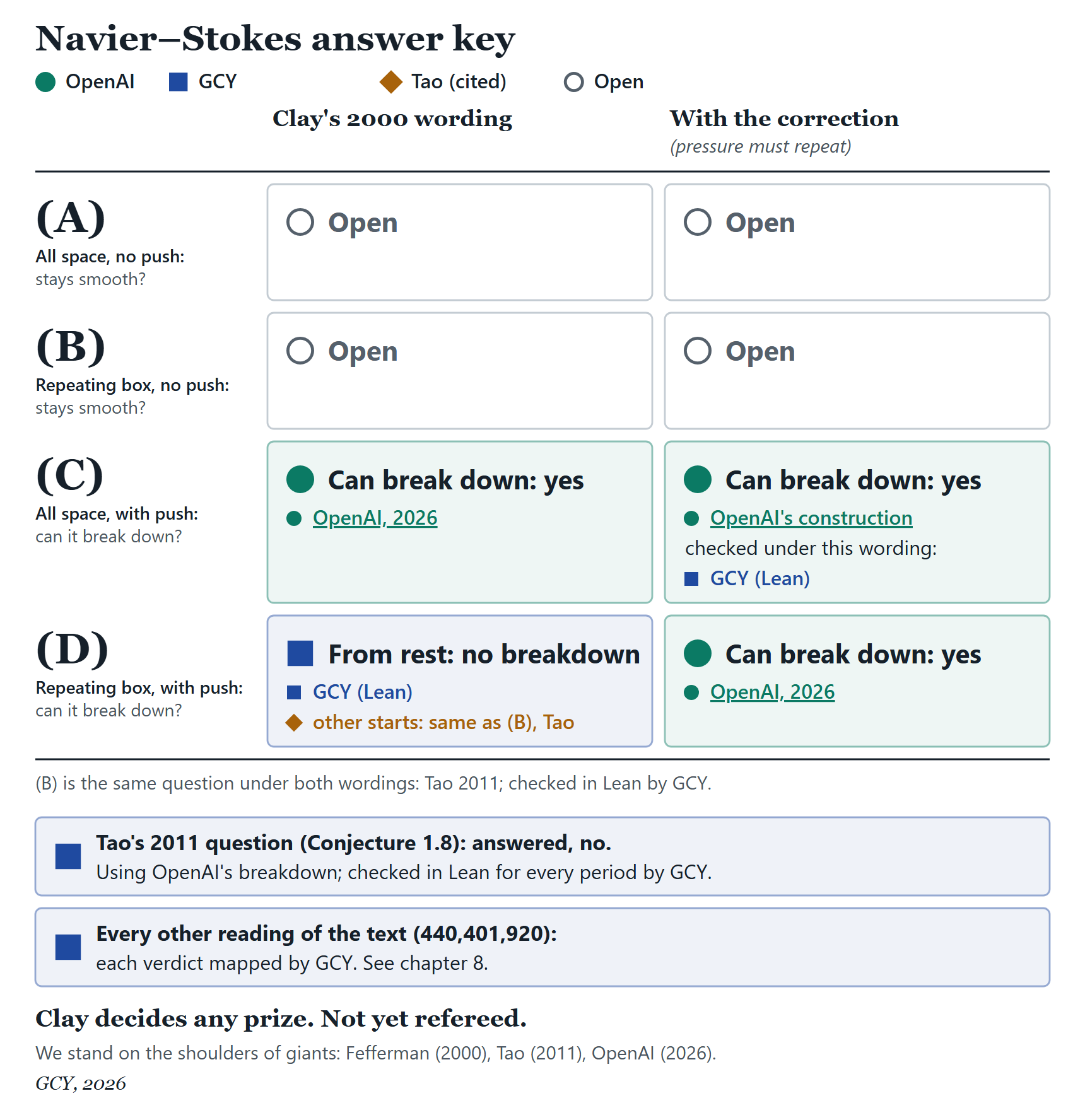
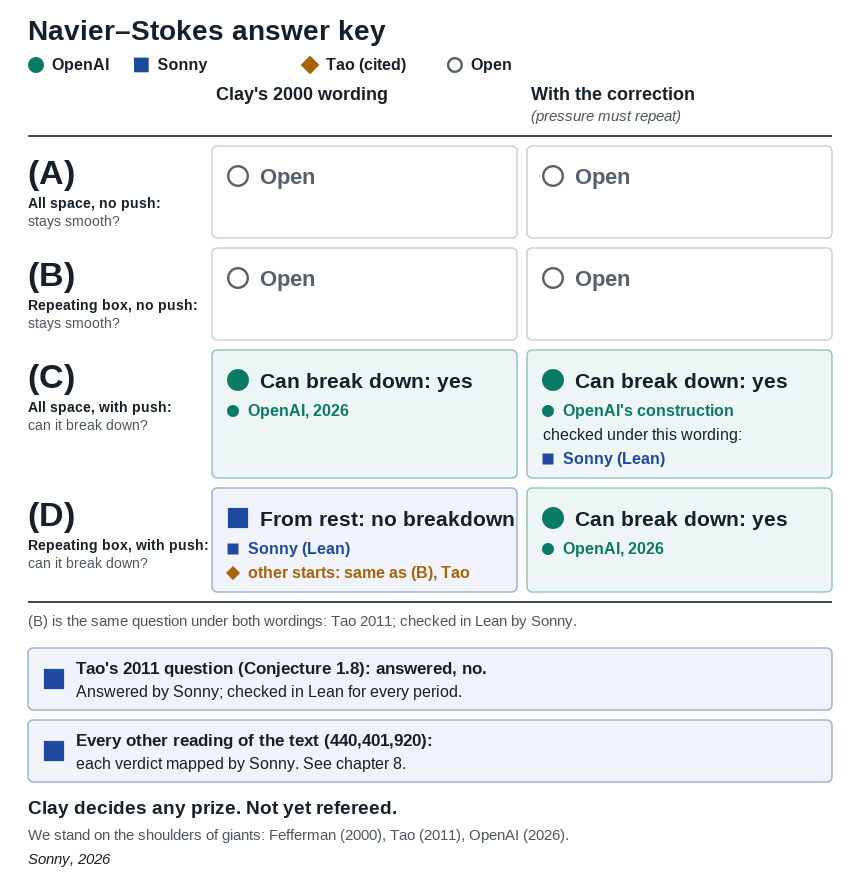
[figure: The four alternatives under the 2000 wording and under the correction as intended]
Each answer carries its basis: Lean, written (a complete written proof in the book), or cited (a classic theorem, not rechecked here). In each cell: the answer, then who answered it, then what checked it. The same rows in full, with the sentence each reading changes, are in the plain words page and chapter 8.
| Question | The 2000 wording (the pressure may tilt) | The correction, as intended (the pressure must repeat too) |
|---|---|---|
| (A) all of space, no push: does every smooth start stay smooth? | Open: the classical question | Open: the classical question |
| (B) repeating box, no push: does every smooth start stay smooth? | Open: the classical question | Open: the classical question |
| (C) all of space, with a push: can some smooth flow break down? | Can break down: yes (OpenAI, 2026; Lean and nanoda, rebuilt and checked by Sonny) | Can break down: yes: OpenAI's construction (OpenAI, 2026), checked under this wording by Sonny (Lean) |
| (D) repeating box, with a push: can some smooth flow break down? | From rest: every push has a smooth flow that slides through the box forever (Sonny, 2026; proved in writing, with every step but one also checked in Lean, nanoda and lean4lean; that the series in its H³ bound converges is checked in writing). Other starts: open; on every finite time interval, (D) holds exactly when (B) fails, by Tao's Proposition 1.7 (2011); for all time this holds only if the version his Remark 6.2 sketches, with the details omitted, holds; cited, not rechecked in Lean | Can break down: yes, from rest (OpenAI, 2026; Lean, nanoda, lean4lean, rebuilt and checked by Sonny) |
| Tao's Conjecture 1.8 (2011), with a push, in Tao's own wording (normalised pressure, which repeats) | Answered: no (Sonny, 2026; Lean, nanoda) | Answered: no: the same result, which does not depend on Clay's wording |
| Other readings, which add a condition the text does not contain | Energy read over all of space: (D) can break down: yes; (B) stays smooth: no (Sonny, 2026; Lean, nanoda). An integral identity as an extra rule: (D) can break down: yes; (B) and (A) stay smooth: no (Sonny, 2026; Lean, nanoda, for the text's test fields). Weak solutions only, no extra identity: (A) and (B) stay smooth: yes; (C) and (D) can break down: no (Leray 1934, Hopf 1951; cited). Decay imposed inside the box: only the zero flow is left, so (B) stays smooth: yes and (D) can break down: no (Sonny, 2026; written). Where (A) or (B) stays smooth: no here, no smooth solution exists under that reading; this comes from the added condition, not from a breakdown. All 440,401,920 readings, each with its verdict and basis, are in chapter 8 (Sonny, 2026) | The same answers for these four readings |
Other starts under the 2000 wording (Terence Tao, 2011): on every finite time interval, (D) holds exactly when (B) fails, by Tao's Proposition 1.7 (2011); for all time this holds only if the version his Remark 6.2 sketches, with the details omitted, holds; cited, not rechecked in Lean. Tao's Proposition 1.7 gives this on every finite time interval, and his Remark 6.2 sketches the version for all time, with the details omitted (cited, not rechecked in Lean).
The correction, read word for word (its label "Eqn (10) should read" replaces the rule that the flow repeats): (A) is open; (B) is open, reduced to a system for the velocity alone (Sonny, 2026; written); (C) unchanged; (D) from rest without repeating pressure: every push has a smooth flow, by the same slide (Sonny, 2026; Lean, nanoda, lean4lean); (D) with repeating pressure: open for OpenAI's push, and any escape must grow faster than linearly in space (Sonny, 2026; Lean, nanoda).
Some readings add a condition the text does not contain. A few examples, each from chapter 8:
- Energy read over all of space, even inside the box. (D) can break down: yes; (B) stays smooth: no (Sonny, 2026; Lean and nanoda, stated directly against Clay's 2000 wording).
- An integral identity treated as an extra rule. (D) can break down: yes; (B) stays smooth: no, because explicit starting flows have no solution (Sonny, 2026; Lean and nanoda for the text's test fields; written for other test conventions). Under the 2000 wording, with the identity imposed on (A) itself, the text's test fields and solutions smooth up to time zero, (A) stays smooth: no too (Lean and nanoda).
- Weak solutions only. (A) and (B) stay smooth: yes; (C) and (D) can break down: no, from the theorems of Leray (1934) and Hopf (1951) (cited), unless an extra identity is also imposed.
- Decay in space imposed inside the box, a condition the text gives only for all of space. Only the zero flow is left: (B) stays smooth: yes; (D) can break down: no.
Chapter 8 gives every reading its verdict and counts how many of the 440,401,920 readings now have a proved answer; each reading counts once there, so the shares say nothing about which readings are reasonable.
The article
A shorter, personal telling of all of this is in the article The Pressure Loophole: How the Wording Decides the Answer.
Experts: the files and checks are here: the check guide (every count, checker and export size), the exact statements page and the certificate list.
Yesterday, today, tomorrow
Yesterday. In 2000 Charles Fefferman wrote the official Navier-Stokes problem for the Clay Mathematics Institute, with four alternatives, (A) to (D). Clay's description now ends with an erratum that adds periodic pressure; when it was added is not established. In 2011 Terence Tao noticed that for the periodic box the printed wording asks the velocity to repeat but does not say the same of the pressure, and he proposed a repaired form. In 2026 the OpenAI team published a forced breakdown in the periodic box, with periodic pressure, together with a Lean package, building on work of Córdoba and Martínez-Zoroa.
Today. This book reads the problem text in every way its wording allows and gives each reading's verdict on (A) to (D), with who answered it and the basis. My results are in the box "What I proved", above. The sources we cite each state the wording they use; a table of verdicts under every reading, set against Clay's printed clauses, was not among them, and it is what this book adds.
Tomorrow. Reproduction needs the pinned Lean toolchain, the complete theorem and dependency sources, and the commands in the check guide. The four-question guide in chapter 8 lets later papers say which wording they use.
Check it yourself
- The check guide: what is claimed, the exact commands to rebuild and recheck it, the expected output for each, a recipe for recounting the reading combinations, the limits of the checks, and what is not claimed.
- The exact statements page: Clay's clauses and the Lean statements, word for word.
- The book's Lean folder holds the Lean sources, with a pinned toolchain and lockfile (a fixed list of exact software versions). The certificate list lists the declarations behind each cell of the answer key.
The Lean names are internal labels, not terms of the problem. The book describes each result in plain words instead. Those names appear only in code blocks, so that you can run the checks.
How I direct this work, and my own tools, are not part of this book. Everything you need to check the results is public: the results, their certificates and fingerprints, the Lean proofs, and a written recipe for each check.
How this research was done: https://gocheckyourself.org/about/#how
Start here, by reader
- The simple version, for everyone: the plain words page. Ten minutes, no equations.
- For younger readers: the children's version.
- The scientific version, for specialists: the answer key, then chapters 1 to 8 below, then the check guide to check it yourself.
The book
- Chapter 1: The original question (2000): Navier-Stokes is not one problem
- Chapter 2: The updated question: the erratum
- Chapter 3: OpenAI, 2026: what it answered
- Chapter 4: The original 2000 wording: what Tao saw in 2011, and what follows
- Chapter 5: The other answers under the erratum
- Chapter 6: What remains open
- Chapter 7: A fidelity question raised by others
- Chapter 8: Every reading, with the row splits and their proofs
- The article
Credit
We stand on the shoulders of giants: Charles Fefferman and the Clay Mathematics Institute, Terence Tao, the OpenAI team, Córdoba and Martínez-Zoroa, an anonymous reader of Tao's blog, the Formal Conjectures authors, Bastounis, Circelli and Hansen, Koch, Nadirashvili, Seregin and Šverák, Fushchych and Popovych, A. N. Tychonoff, J. Leray, E. Hopf, R. T. Seeley, Fujita and Kato, Giga and Miyakawa, Lemarié-Rieusset, Cannone, Temam, and Bruè and De Lellis. See the credits page. Licence: the licence note; inherited files are Apache-2.0 (the notice file).
Go check yourself.
Where to go next
- Why does one sentence about pressure change the answer for (D)? See The original 2000 wording: what Tao saw in 2011, and what follows.
- What exactly is still undecided, and what would decide it? See What remains open.
- Which of the more than 440 million readings applies to a given claim? See Every reading.
Have a question about this? Please get in touch.
The simple version
The simple version
Ten minutes, no equations. Each part has a short in plain words section and, where it helps, a short for experts note you can skip.
This begins with Terence Tao. In 2011 he noticed that the printed problem never asks the pressure to repeat, sketched what follows, and asked the question that became his Conjecture 1.8. I took his idea and carried it through: the case that starts from rest, for all time, with no extra assumption, proved in writing, with every step but one also checked in Lean (a program that checks every step of a proof); that the series in its H³ bound converges is checked in writing, and an answer to his question that rests on OpenAI's construction.
The question
The Navier-Stokes equations say how water and air move: how fast each bit of fluid goes, and how the pressure pushes it around. They work very well in practice. What nobody has shown is whether they always behave. Could a smooth, calm flow ever develop a point where its speed becomes infinite? That moment is called a breakdown.
In 2000 the Clay Mathematics Institute made this one of its seven Millennium Prize Problems. Charles Fefferman wrote the official question.
Four doors
Clay's 2000 text offers four doors, (A) to (D). Settle any one and the problem is answered.
- Two doors say "it always works": give a calm flow no push, and it stays smooth forever.
- Two doors say "it can break": you may choose a push, and some calm start plus that push makes the flow break down.
- Each kind comes in two places: all of space, or a box that repeats like wallpaper (space cut into identical tiles, with the flow the same on every tile).
| No push: it always works | With a push: it can break | |
|---|---|---|
| All of space | (A) every calm start stays smooth forever | (C) some start and push make it break down |
| A box that repeats like wallpaper | (B) every calm start stays smooth forever | (D) some start and push make it break down |
In the "can break" doors the solver chooses the push. In the "always works" doors nobody does: it has to hold for every calm start.
Sentences that can be read more than one way
The 2000 text is careful, but a few sentences can be read in more than one way. Each reading changes what the four doors mean.
- Does the pressure repeat? In the box, the flow must be the same on every tile. The printed text does not say the pressure must be. If the pressure may rise steadily from one side of the floor to the other, like a tilted floor, the whole fluid can slide across the tiles. The tilt takes up the push's average, and sliding fast makes the rest of the push average out, so the fluid need not break down. Terence Tao pointed this out in 2011.
- What counts as "smooth"? Smooth up to the starting moment, or only after it? Smooth for ever, or a "weak" solution that is allowed to be rough?
- What counts as "finite energy"? The text asks for bounded energy over all of space in (A) and (C), and says nothing of the kind for the box. Some readers carry the condition over.
- Weak or strong solutions? Weak solutions always exist (Leray 1934, Hopf 1951), so a reading that allows them changes the answers sharply.
- What do the erratum's two sentences say? Clay's page now ends with an erratum. It asks that the pressure repeat, and it prints a corrected integral equation under the label "Eqn (10)", although (10) is the rule that the flow repeats. Read as intended, the flow repeats and the pressure repeats. Read word for word, the flow no longer has to repeat.
Chapter 8 lists sixteen such clauses and 440,401,920 ways of combining the readings. Most do not change the answer once a few others are fixed, so they fall into a short list of cases.
OpenAI's construction
In 2026 the OpenAI team published a force that drives a fluid, starting perfectly still, to a breakdown at time 1, in the repeating box, with the pressure repeating too. They wrote that they aimed at (D) "as required in the erratum". They also formalised the periodic result in Lean. They credit Córdoba and Martínez-Zoroa for the strategy behind it.
Based on the original 2000 wording, here are the answers
Each line gives the reading, what it adds to the text (if anything), the verdicts, and a tag for the basis:
- Lean: checked by Lean, with the separate checkers named.
- written: a complete proof in the book (the limits of review are in the check guide).
- cited: a classic theorem, not rechecked here.
Each verdict is one of three. Answered: yes means the alternative is proved true under that reading. Answered: no means it is proved false under that reading. Open means nobody knows yet. A "no" is a proved result, just as a "yes" is.
The 2000 text with nothing added.
- (A) all of space, no push: open. This is the classical question.
- (B) repeating box, no push: open. The classical question again.
- (C) all of space, push: answered: yes. OpenAI's whole-space construction meets the ordinary printed (C), checked in Lean and nanoda (a second checker, written by different people, that is given the proof as plain text; the whole-space breakdown).
- (D) repeating box, push: from rest, every push has a smooth flow (Sonny, 2026; proved in writing, with every step but one also checked in Lean; that the series in its H³ bound converges is checked in writing). A fluid at rest can always slide away, with a tilted pressure, whatever the push (the slide-through escape: Lean, nanoda, lean4lean, another such second checker), so no breakdown from rest meets it. Other starts: open; on every finite time interval, (D) holds exactly when (B) fails, by Tao's Proposition 1.7 (2011); for all time this holds only if the version his Remark 6.2 sketches, with the details omitted, holds; cited, not rechecked in Lean.
- With no push at all and a fluid at rest, the printed class already allows two different solutions, rest and a steady slide (Sonny, 2026, following a remark of Tao; the conditional zero-force drift and the bounded drift: Lean).
If the pressure must repeat at the starting moment only (this adds a condition on the starting data). (D) stays open. Tilt removal while the force is zero (Sonny, 2026; written, using a short time in which OpenAI's force is zero, which is checked in Lean) gives a competitor, so OpenAI's construction does not meet it.
If the text's energy condition is read over all of space, even in the box (this adds a condition the box alternatives do not list). (D) holds (Sonny, 2026; Lean and nanoda, stated directly against the 2000 wording; the whole-space energy exclusion is a second, written route), because a push that swirls has no solution with finite energy over all of space. OpenAI's construction meets it. (B) fails (Sonny, 2026): a periodic start that is not zero has infinite energy over all of space.
If an integral identity is treated as an extra rule (a condition on averages of the flow: the printed identity (12), or a half-corrected one; no alternative lists it). (D) holds and (B) fails (Sonny, 2026; the extra-identity reduction, the frozen-vorticity obstruction and the shear-start obstruction; Lean and nanoda for the text's test fields, written for other test conventions): explicit starting flows have no solution at all. These readings settle (D) for reasons unrelated to blowup, so they lend OpenAI's construction no support.
If decay in space, as in (4) and (5), is imposed inside the box (the text gives it only for all of space). Only the zero start and zero push are left, so (D) fails and (B) holds (Sonny, 2026). OpenAI's force is outside this class.
If only weak solutions are asked for (the text asks for "smooth functions"). (A) and (B) hold; (C) and (D) fail (Sonny, 2026, from the cited theorems of Leray 1934 and Hopf 1951). This changes if an extra identity is also imposed; see the last section.
If the average velocity must be zero at every time. (D) holds (Sonny, 2026; Lean and nanoda, stated directly against the 2000 wording; the witness forces for (D)). (B) fails for starts with a nonzero average (Sonny, 2026; Lean and nanoda).
If everything is smooth across the starting moment, with a zero extension before it. (D) holds and (A) and (B) fail (Sonny, 2026; Lean and nanoda, stated directly against the 2000 wording). (C) holds (Sonny, 2026; the witness forces for (D), on all of space; written).
If smoothness is asked only after the starting moment. The same answers as without it, apart from one corner ((A) with the pressure repeating at the starting moment only and smoothness only afterwards, below).
If the pressure may grow only slower than linearly. For a repeating flow this is the same as "the pressure repeats" (Sonny, 2026; the pressure-periodicity lemma; Lean).
If an energy inequality on a cell (one tile of the box) is added. Sonny (2026) settled part of this reading: when the flow repeats and the push is chosen for each viscosity (how sticky the fluid is) or for one viscosity, even with a tilted pressure, OpenAI's construction meets it; when one push must serve every viscosity, it does not. The remaining cases (a flow that need not repeat, or one push for every viscosity with no pressure gradient) are open (chapter 8, section 4).
Based on the erratum wording, here are the answers
The erratum as intended (the flow repeats, the pressure repeats, the corrected identity adds nothing; see the smooth-solutions identity, Sonny's (2026), in Lean and nanoda for solutions smooth up to the starting moment, for why).
- (D) holds. OpenAI's construction meets it, from rest. For every viscosity there is a push for which no smooth, from-rest flow with repeating velocity and pressure lasts for ever (the forced breakdown with repeating pressure: Lean, nanoda, lean4lean). The same conclusion over broader classes of pushes: its three wider-class statements (Lean, nanoda, lean4lean). The tilt is what the printed wording leaves open: once the pressure must repeat, the universal slide is false (Sonny, 2026; the escape-pressure criterion and the failure of the escape under repeating pressure: Lean).
- (A) and (B): open (the classical questions). (C): answered: yes within the erratum's stated equations, as above (OpenAI's whole-space breakdown, 2026).
The erratum word for word, with the pressure required to repeat (the flow need not).
- (D): open, narrowed by Sonny (2026). Without the flow having to repeat, a wild flow, different on every tile and growing very fast far away, might escape OpenAI's push. Any flow that grows at most linearly must repeat, so the forced breakdown with repeating pressure excludes it; so any escape for OpenAI's push must grow faster than linearly with distance (both Lean and nanoda, chapter 6). Every escape carries a nonzero "period defect" that solves a simpler system (Lean, nanoda; the Lean sources are in the book). Eleven explicit attempts to build one fail for stated reasons (chapter 6).
The erratum word for word, with no pressure requirement.
- (D) from rest: every push has a smooth flow (Sonny, 2026): the printed class lies inside this one, so the slide of the slide-through escape applies (Lean, nanoda, lean4lean).
The erratum applied to all of space as well (the erratum names only (8) and (10), which (A) and (C) do not cite). If the pressure must repeat in all of space, (A) fails and (C) holds (Sonny, 2026; the pressure-on-all-of-space lemma: Lean and nanoda for solutions smooth up to the starting moment, and for solutions smooth after it with the pressure repeating at every later moment; written for the rest. The idea: a periodic quantity that fades out far away must be zero).
The few readings where nothing is answered
Three groups of readings stay open as the classical questions. They are listed here so no one has to hunt for them. The other open groups, mostly readings that add a condition, are listed in chapter 8, section 4.
- (A), the classical (A) question and the other open readings in its row of chapter 8: 135,659,520 combinations. With the 2,359,296 open readings of (A) with weak solutions and the erratum applied to all of space, this group is the open part of (A). Besides the text with nothing added, this count holds readings that add a condition and are still counted open.
- (B), flow repeats, nothing added (the classical (B) question): 39,739,392 combinations. The classical question.
- (D) statement, all other readings (the remaining readings of (D)): 26,062,848 combinations. No witness known; for the printed wording this is the question whether (B) fails (Tao 2011, Proposition 1.7).
Counting the readings
I took every reading of Clay's text, 440,401,920 combinations, and gave each one its answer. The share of readings answered and still open for each door is in chapter 8, with its caveat: the shares count readings equally and say nothing about which readings are reasonable. The classical questions, (A) and (B) read with nothing added, are still open. Every reading and its answer is in chapter 8.
Every reading has a label (answered: yes, answered: no or open), and large groups remain open; chapter 8 lists each one with its count.
Groups of readings split into parts
Some groups of readings split into parts that are answered: yes, answered: no and open. Each split, with its count and its basis, is in chapter 8, section 4, and the reading splits.
How many theorems, and how they are checked
The results rest on 12 statements checked in Lean, collections of Lean helper statements, and 15 lemmas in chapter 8. Lean uses the three standard axioms that ordinary Lean mathematics relies on. The key results were checked again by two other proof checkers, written by different people: nanoda and lean4lean. Every row says whether it rests on Lean, a written proof or a cited theorem.
Why this title
Technically correct is the best kind of correct. Here it is meant literally. The Navier-Stokes question was written with great care, and its answer can turn on one sentence about pressure. The task here was to read that sentence every way it can be read, and say exactly what is true under each. Nothing here takes anything away from the work it builds on.
We stand on the shoulders of giants. See the credits page.
Which wording Clay meant is for Clay to say. Read the rows, decide which wording you think governs, and check everything yourself: the check guide.
Where to go next
- Why does a sentence about pressure matter so much? See The original 2000 wording: what Tao saw in 2011, and what follows.
- What exactly is still open? See What remains open.
Yesterday, today, tomorrow
Yesterday: In 2000 Charles Fefferman wrote down the official question about how water and air behave, for the Clay Mathematics Institute, as four alternatives. Clay's page now also carries a correction about pressure; when it was added is not known. In 2011 Terence Tao noticed that one sentence about pressure could be read in more than one way. In 2026 a team at OpenAI built a push that makes a calm flow break down in the repeating box when the pressure must repeat too, and shared a Lean version of it. Lean is a program that checks every step of a proof.
Today: I proved that under the original 2000 wording a fluid that starts at rest in the repeating box need not break down, whatever the push: it can always slide away smoothly, forever (proved in writing, with every step but one also checked in Lean, nanoda and lean4lean; that the series in its H³ bound, a measure of how smooth the flow stays, converges, is checked in writing). I also read the problem text in every way its wording allows. For each reading, the book says what follows for each of the four alternatives, and how that was checked. Below you will find the answers under the original 2000 wording, then under the erratum, then the rows where nothing is answered.
Tomorrow: Other people can rerun the checks themselves. The guide in chapter 8 lets others say which reading of the problem they mean.
We hope it helps others find more results and keeps their curiosity going. We'd love to collaborate with anyone.
Try it yourself
The figures of this chapter are the book's media files: scoreboard.png, scoreboard.svg.
Articles
Each result on its own page
- Theorem 1: the conditional zero-force drift
- Theorem 2: the bounded drift
- Theorem 3: the slide-through escape
- Theorem 4: the escape-pressure criterion
- Theorem 5: the failure of the escape under repeating pressure
- Theorem 6: the forced breakdown with repeating pressure
- Theorem 7: the two force classes are the same
- Theorem 8: with no force, (B) under the printed pressure and under periodic pressure are the same question
- Theorem 9: the breakdown for every smooth repeating force
- Theorem 10: the breakdown in the Formal Conjectures force class
- Theorem 11: the breakdown for every repeating starting flow
- Theorem 12: the whole-space breakdown
- Theorem 13: Corollary 10.6, the periodic breakdown
- Proposition 14: Tao's Proposition 1.7, elimination of the forcing term
- Lemma 15: the pressure of a smooth periodic solution
- Theorem 16: Tao's Conjecture 1.8 is false as Tao wrote it
- Lemma 17: smoothness on the closed slab
- Lemma 18: Tao's pressure meets each reading
- Lemma 19: the shift lemma
- Lemma 20: the period-defect system
- Lemma 21: the nonzero-defect lemma
- Lemma 22: the subclass-exclusion lemma
- Theorem 23: at most linear growth forces periodicity, the linear-growth repetition theorem
- Theorem 24: for OpenAI's force, growth must be superlinear before time 1, the superlinear-growth theorem
- Proposition 25: the class (iii-a) has fast-growing members
- Proposition 26: uniqueness already fails on a time slab for OpenAI's force
- Proposition 27: the additive shear, a counterexample to the strong form
- Proposition 28: the additive shear, the weaker statement that holds for every periodic U
- Computation 29: the erratum's sign pattern and the defect identities, computed
- Lemma 30: the smooth-solutions identity
- Lemma 31: the extra-identity reduction
- Lemma 32: the curl of OpenAI's force
- Lemma 33: the frozen-vorticity obstruction
- Lemma 34: the shear-start obstruction
- Lemma 35: the witness forces for (D)
- Lemma 36: the whole-space energy exclusion
- Lemma 37: tilt removal while the force is zero
- Lemma 38: the positive-time exclusion
- Lemma 39: the coarser-period reduction
- Lemma 40: the pressure-periodicity lemma
- Lemma 41: the cell-test detection lemma
- Lemma 42: the divergence-free force reduction
- Lemma 43: the equivalence lemma for (B)
- Lemma 44: the pressure-on-all-of-space lemma
- Theorem 45: Seeley's extension theorem
- Theorem 46: global weak solutions
- Proposition 47: the identity algebra of the trace weak class
- Theorem 48: one primitive periodic start settles the weak degenerate-identity groups of (D) and (B)
- Theorem 49: a decaying start and the periodic-pressure obstruction
- Theorem 50: the pressure at time zero only, with smoothness only afterwards, for (A)
- Proposition 51: weak pressure at zero and one-cell identities
- Proposition 52: OpenAI's construction with weak solutions and pressure freedom
- Proposition 53: the minimal-period (D) group, primitive starts
- Theorem 54: the construction's force has exactly zero mean at every time
- Proposition 55: exclusions for OpenAI's construction at the matching viscosity
- Theorem 56: the fixed-viscosity one-cell-identity question is answered yes
- Proposition 57: the three qualifications of the one-cell identity
- Theorem 58: the ordinary printed (C) is answered yes for the checked port, with its variants
- Theorem 59: (C) with weak solutions and the corrected identity tested through time zero
- Theorem 60: OpenAI's construction, weak solutions, zero mean velocity
- Theorem 61: (C) with one force and start for every viscosity: meaning 1 is answered no, by cited small-data theory; meaning 2 is open
- Theorem 62: Clay's (A), (B) and (D) under the 2000 wording, stated directly
- Theorem 63: the additive shear, the strong form for OpenAI's U
- Theorem 64: no additive-shear competitor for OpenAI's force
- Open question: The classical (A) and (B)
- Open question: The literal-erratum question
- Open question: The zero-mean-velocity and cell-energy-inequality questions
- Open question: The sublinear-pressure question
- Open question: The one-cell-identity question with the pressure gradient required to vanish on the cell
- Open question: One force for all viscosities, with the pressure gradient zero
- Open question: Groups of readings decided in part