The Invisible Golden Snitch
the exact path of every possible Snitch and the corner of their curve: PROVED (written proof, independently re-derived); two chase results: PROVED under stated conditions; sample chases: COMPUTED for speed ratios 2, 3, 5 and 7; catching the Snitch exactly, at every speed ratio above 1: open. Not yet refereed.
proved in writing 4 · cited 1 · computed 1 · proved in writing; the program is not published here 1 · computed; the program is not published here 1 · open 1
Overview
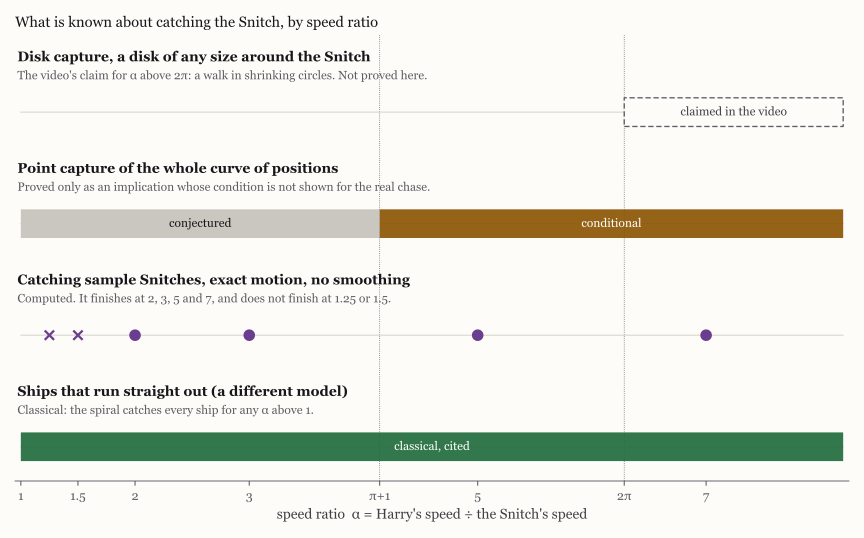
Harry is looking for a Golden Snitch he cannot see. It is somewhere on a circle around him, at a distance he knows, and it flies more slowly than he does. The moment he moves, it flies straight away from where he now stands. Is there a path that is sure to catch it? The riddle comes from Don't Panic Math, and catching it exactly at every speed ratio above 1 is open. This book works out the exact path of every possible Snitch while Harry runs straight. At the time d/(V − v) their curve has a pointed tip at Harry's feet, its two arms leaving at angle arccos(1/α) either side of straight behind, where α is the speed ratio. That is proved in writing and independently re-derived. Two chase results are proved only as implications: if the curve is smooth up to Harry and the Snitches stay within a half-turn as seen from him, the length left falls by at least (α − π − 1)v per unit time. Those conditions are not shown for the real chase, so a catch for α above π + 1 is conditional. Chases of sample Snitches finish at speed ratios 2, 3, 5 and 7 and fail at 1.25 and 1.5. That is computed. Every number can be checked from the written recipes and one results file with a SHA-256 fingerprint.
Check it yourself
The check guide for this book · How to check a result yourself
Cite: Sonny (2026). The Invisible Golden Snitch (preliminary). Go check yourself. https://gocheckyourself.org/read/golden-snitch/everyone/
Start here
What this book shows
- My result. While Harry runs straight, each possible Snitch moves along a curve with a closed formula (one you can write down in full): Bouguer's pursuit-curve integral (1732; the classical formula for the path of a chaser), run backwards in time. At time d/(V − v) that curve has a pointed tip at Harry's feet, its two arms leaving at angle arccos(1/α) (the angle whose cosine is 1/α) either side of straight behind. PROVED (written proof, independently re-derived).
- Two chase results, under stated conditions. If the uncaught curve is smooth up to Harry, he consumes it at a steady rate; if the Snitches also stay within a half-turn as seen from him, the length left falls by at least (α − π − 1)v per unit time. PROVED (written proof, independently re-derived), as an implication. Those conditions are not shown for the real chase, so catching the Snitch for α above π + 1 is conditional.
- Chases of sample Snitches with the exact motion finish at α = 2, 3, 5 and 7 and fail at 1.25 and 1.5. COMPUTED. Catching the Snitch exactly, at every speed ratio above 1, is open.
- Why it matters. Here the target reacts: it steers away from the pursuer, so the places it can be change shape with every step Harry takes. A proof that the smoothness and angle conditions always hold would decide every ratio above π + 1 at once.
- Every result is listed in the theorem library.
The question
A Golden Snitch hides somewhere on a circle around Harry, and Harry cannot see it. He knows how far away it is and how fast it flies, and he is faster. He does not know which way to go. The moment he moves, the Snitch darts straight away from wherever he now stands. Is there a path that is sure to catch it, whichever way it started?
The riddle comes from Don't Panic Math, in the video "The Invisible Golden Snitch Riddle". Thank you for the question. It sends people to a notebook, and this book is what came out of ours.
[video: The Invisible Golden Snitch Riddle]
The rules are short. Harry flies at speed V and the Snitch at a smaller speed v. Call α = V/v the speed ratio; it is above 1. The Snitch starts at a distance d from Harry, at an angle he is not told. At every instant it flies directly away from the point where Harry is at that instant. Harry sees nothing until he touches it.
"Caught" has two meanings. Catching the Snitch within a small distance ε is disk capture. Catching it exactly is point capture. The video claims disk capture for α above 2π, by a walk along circles that shrink. Point capture for every α above 1 is the question the video leaves open. It is open here too.
Where to go next. What does a search look like when the target cannot be seen? See the question. What if the Snitch ran in a straight line instead? See fog and spirals.
Why it matters
Pursuit is one of the oldest problems in applied mathematics. Pierre Bouguer studied pursuit curves (the paths taken by someone chasing a moving target) in 1732, and for a ship that flees along a straight course in fog, the answer is a logarithmic spiral (a spiral that widens by the same factor each turn; the classical "trawler problem"; see Nahin 2007). Here the target reacts. It steers away from the pursuer, so the places it can be change shape with every step Harry takes. A search that changes what it searches is harder to picture, and this puzzle is built on that difficulty.
Where to go next. Why does the spiral stop working? See fog and spirals.
What answering it would help with
No use outside mathematics is known to us. Inside it, there are three possible gains.
- A path for every speed ratio above 1 would show that a blind pursuer who is faster always wins against a target that only runs away, and may point to a method for other reacting targets.
- A speed ratio below which no path works would be a threshold, and would mark where blind pursuit stops being possible.
- A proof that the smoothness and angle conditions of chapter 4 always hold would decide every ratio above π + 1 at once.
Further research is recommended on all three.
Where to go next. Which condition would decide the ratios above π + 1? See the chase along the edge.
What our research shows
I worked out the exact path of every possible Snitch while Harry runs in a straight line, and I followed those paths to a corner.
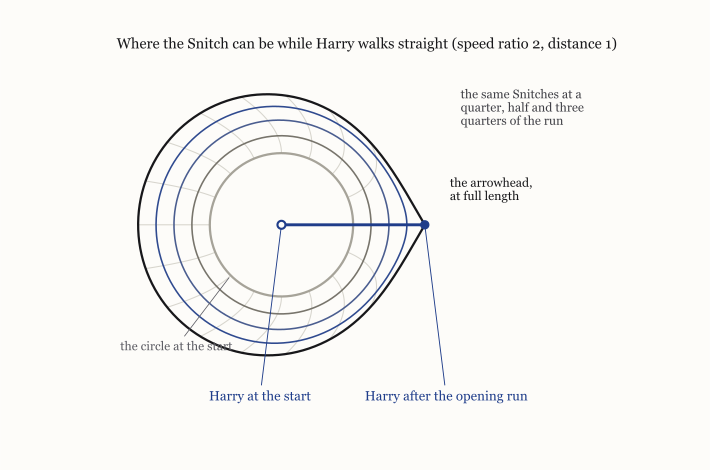
The exact path (Sonny, 2026). While Harry runs straight, each possible Snitch moves along a curve with a closed formula. The formula is the classical pursuit-curve integral of Bouguer (1732), run backwards in time. PROVED (written proof, independently re-derived).
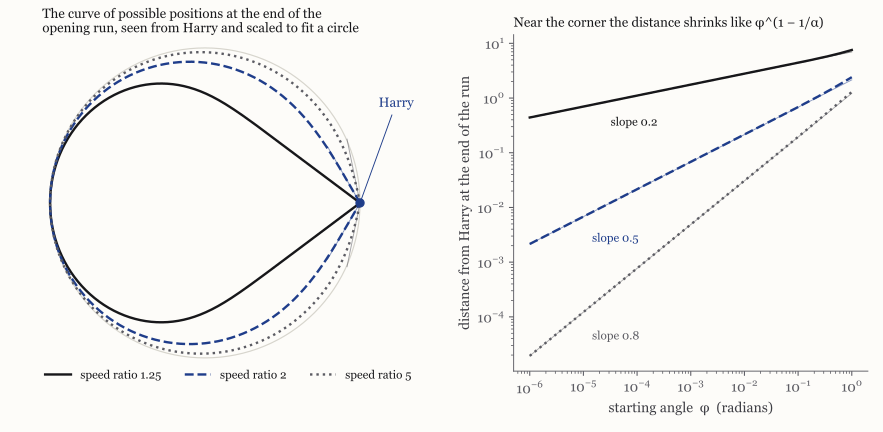
The corner (Sonny, 2026). Harry runs straight for the time d/(V − v). At that moment the curve of possible positions has a pointed tip at Harry's feet. Seen from Harry, its two arms leave at angle arccos(1/α) either side of straight behind, and the distance of the nearest Snitches shrinks like φ to the power 1 − 1/α. PROVED (written proof, independently re-derived). The numbers match to better than 2e-7 at a starting angle of 1e-6 radians. COMPUTED.
The tip law and the length balance (Sonny, 2026). If the uncaught curve is smooth up to Harry, he consumes it at a steady rate, and the length left falls by at least (α − π − 1)v per unit time whenever the Snitches stay within a half-turn as seen from Harry. PROVED (written proof, independently re-derived), as an implication. The smoothness and the half-turn condition are not shown for the real chase, so catching the Snitch for α above π + 1 is conditional.
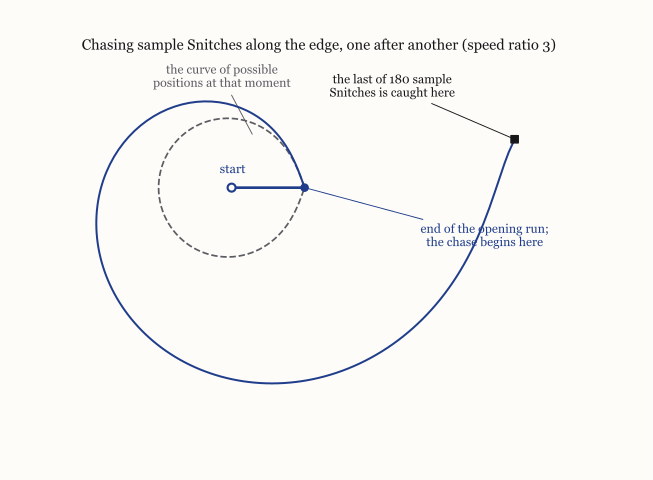
Chases of sample Snitches (Sonny, 2026). With the exact motion and no smoothing, a chase of 1,440 evenly spread sample Snitches finishes at α = 2, 3, 5 and 7, in 23.43, 7.21, 2.64 and 1.57 units of d/v. COMPUTED. The times still rise as the sample doubles, so no limit is shown. At α = 1.25 and 1.5 every chase we ran fails: the positions run away.
The question itself. Point capture for 1 < α ≤ π + 1 is CONJECTURED, with numerical support only from α = 2 upward. Point capture at every ratio above 1 is open.
- What this is
- the exact motion of the possible Snitch positions while Harry runs straight, the corner of their curve, two conditional results about chasing along that curve, and computed chases of sample Snitches (Sonny, 2026).
- Still open
- a path that catches the Snitch at every speed ratio; the video's claim for α above 2π; a catch of the whole curve by any of the sample chases.
- Checked by
- direct numerical integration, a finite-difference test (a numerical check that compares nearby values) of the stretching identity, and chases run with the exact motion; an independent replay re-derived the formulas and reproduced the chase results.
Yesterday, today, tomorrow
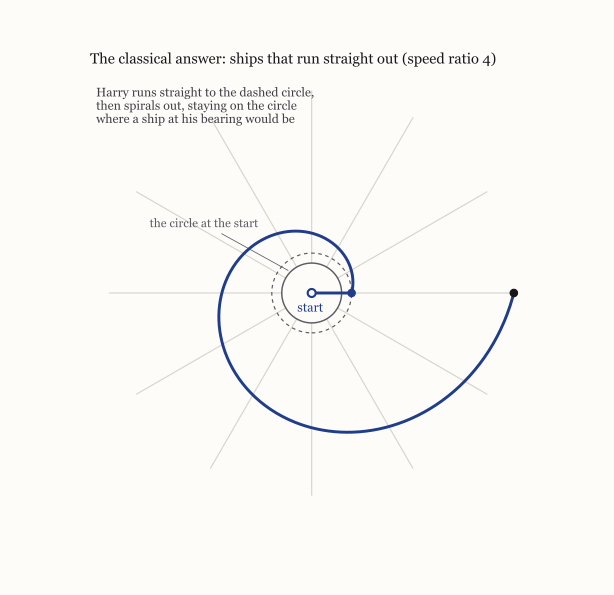
Yesterday. Bouguer (1732) studied pursuit curves. The classical "trawler problem" gives the spiral answer (see Nahin 2007) for a ship that flees in a straight line. Don't Panic Math put the invisible Snitch to the public, with the rules, a shrinking-circle walk for disk capture and a two-part plan: run out to the circle, then sweep along its edge.
Today. I found the exact path of each possible Snitch while Harry runs straight, found the corner of their curve, and proved two chase results that hold under stated conditions. I ran chases of sample Snitches with the exact motion. They finish from α = 2 upward and fail at 1.25 and 1.5.
Tomorrow. Others can try to show the smoothness and angle conditions for the real chase, which would settle every ratio above π + 1. They can also look for a path that works at ratios near 1, or show that none does. Further research is recommended.
Where to go next. What is proved, and what only under a condition? See what we proved and the chase along the edge.
Check it yourself
What ships: one results file with every number quoted here, a SHA-256 fingerprint (a 64-character code computed from a file; change one bit and the code changes) for it, five figures, and a written recipe for each check. A recipe gives the formula, the numbers to start from and the numbers to expect, so a few lines of your own code will do. The recipes are in the verification guide, which starts with the fingerprint check:
sha256sum -c SHA256SUMS.txt  # Linux
shasum -a 256 -c SHA256SUMS.txt   # macOS
CertUtil -hashfile <file> SHA256
The upper command runs inside the certificates folder on Linux (macOS: the shasum line). The lower one does the same for one file on Windows. No Lean proof is shipped in this book (Lean is a proof-checking program that tests every step of a proof against fixed rules); the proofs are written and independently re-derived.
The programs are not part of this book.
About this research: https://gocheckyourself.org/about/#how
Where to go next. What does each check show, and what does it leave open? See the verification guide.
The chapters
We stand on the shoulders of giants. The credits page lists the work this builds on.
Where to go next
- Coming to the riddle fresh? Start with the question, then fog and spirals.
- Want the results and their limits? See what we proved and the open question.
- Want to rerun a check? See the verification guide.
Have a question about this? Ask it
The simple version
The simple version
Ten minutes, no equations. Each part has a short in plain words section and a short for experts note you can skip.
The question
Harry is looking for a Golden Snitch he cannot see. It is somewhere on a circle around him, at a distance he knows, and it flies slower than he does. When he moves, it flies straight away from him. Is there a path that is sure to catch it? Don't Panic Math asked this in the video "The Invisible Golden Snitch Riddle". Thank you for the question.
If the Snitch ran straight out
A ship in fog that sails in a straight line is caught by a spiral. The faster ship runs straight out to the circle where the ship would now be, then spirals round on that circle. It meets every ship once. The time is finite for every speed ratio above 1, and huge when the ratio is close to 1.
What shape the possible places take
While Harry flies straight, every possible Snitch follows a path we can write down exactly. Together they form a curve. It starts as a circle and ends the run as an arrowhead with its point at Harry. The arms of the arrowhead lean back at an angle that depends only on the speed ratio.
Flying along the edge
After the opening run Harry flies along the arrowhead's edge, eating it as he goes. If the edge is smooth and does not turn more than half a turn as seen from Harry, the length left shrinks fast enough to be caught whenever Harry is more than about 4.14 times as fast as the Snitch. Nobody has shown that those two conditions hold during the real chase, so that result is conditional.
What the computer says
We replaced the curve by a few hundred or a thousand sample Snitches and let Harry catch them one by one, with the exact motion and no smoothing. It finishes when Harry is 2, 3, 5 or 7 times as fast. It does not finish at 1.25 or 1.5: the positions run away. Catching samples is not catching every Snitch, and the times still creep up when we add samples.
What is open
Can Harry always catch the Snitch, however little faster he is? That is open. For speeds between 1 and about 4.14 times, we guess yes (CONJECTURED), with computer support only from 2 times upward. For larger ratios the answer is yes if the smoothness and half-turn conditions hold, and nobody has shown them.
Experts: the files and checks are here: verification guide.
We hope it helps others find more results and keeps their curiosity going. We'd love to collaborate with anyone.
Try it yourself
The figures of this chapter are the book's media files: chase-along-the-edge.svg, classical-spiral.svg, possible-positions.svg, the-corner.svg, what-is-known.svg.
Each result on its own page
- Proposition 1: the spiral against ships that run straight out
- Theorem 2: the exact path of a Snitch while Harry runs straight
- Theorem 3: the corner at the end of the opening run
- Result 4: the length of the curve at the end of the opening run
- Theorem 5: the tip law
- Theorem 6: the length balance, and capture for if a condition holds
- Remark 7: the sawtooth step, a heuristic
- Result 8: chases of sample Snitches with the exact motion
- Conjecture 9: point capture for